2025 Report: SLAPPs in Europe – Democracy in the Dock
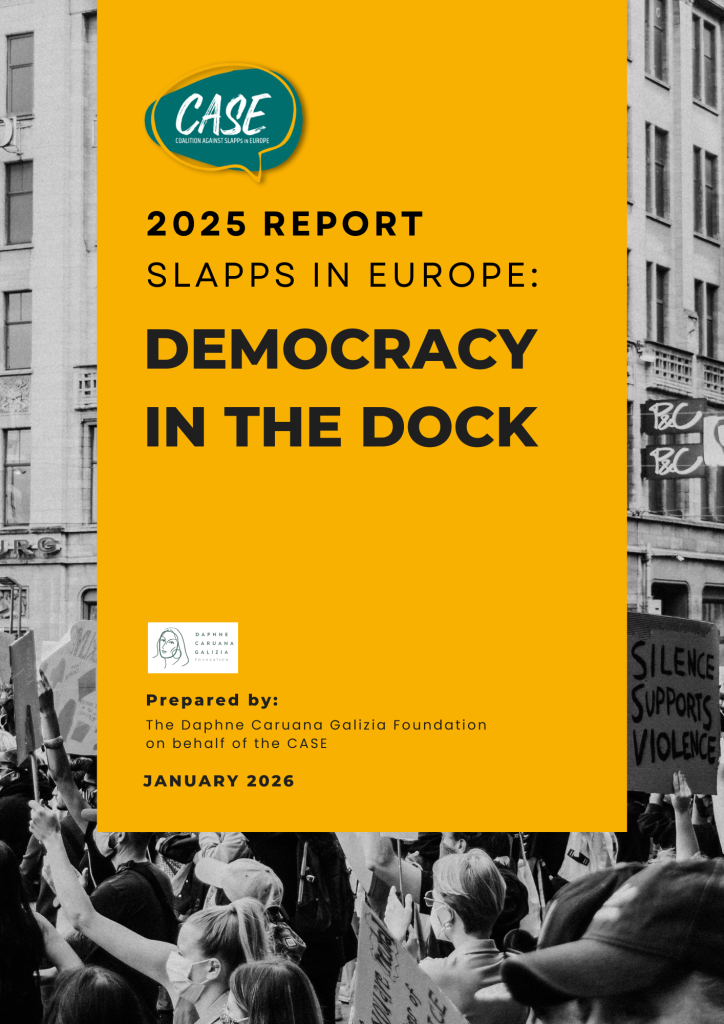
The 2025 report from the Coalition Against SLAPPs in Europe (CASE) and the Daphne Caruana Galizia Foundation finds that the number of abusive lawsuits continues to rise across Europe, even in the face of the EU’s new anti-SLAPP law, which came into force in May 2024 and which countries have until May 2026 to transpose into national law.
A total of 167 new abusive lawsuits were added to CASE’s database in 2024 – an increase from 166 in 2023. Additionally, new cases were identified for previous years, bringing the total number of documented SLAPPs to 1,303 – up from 1,049 the previous year.
The main findings of this report are as follows:
- Documented SLAPPs reached 1,303 since 2010, with 167 filed in 2,024 alone, and the problem is now identified in 43 countries, adding Montenegro and Andorra to the map. The threat has evolved, moving beyond traditional defamation to exploit complex legal areas like data protection and intellectual property. These findings underscore the urgent need for more robust, comprehensive anti-SLAPP protection measures on both national and international levels.
- Powerful actors are strategically diversifying their legal claims beyond traditional defamation to exploit procedural complexities and circumvent the public interest defences established for free expression. While the large majority of SLAPPs are based on national defamation laws, the data confirms the rising use of alternative legal vehicles.
- The data confirms that the most common litigants are those in positions of power, namely businesses and politicians. The political dimension of the SLAPP threat is growing, with cases initiated or supported by state-aligned entities or powerful foundations common in countries experiencing rule of law backsliding.
- This strategy involves the use of SLAPPs to enforce an official historical narrative and restrict debate on historical memory, such as in cases filed against academics, thereby stifling intellectual and political dissent.
- The report’s total of 1,303 documented SLAPPs is acknowledged to be the “tip of the iceberg.” This is because the majority of censorship is achieved at the pre-litigation stage through the use of aggressive legal threat letters and cease-and-desist demands. Furthermore, the threat remains acute because SLAPP targets continue to face the threat of custodial sentences under national criminal defamation laws. This ultimate chilling effect, combined with the fear of retaliation, ensures that many threats or cases never enter the public domain.
- The adoption of the EU Anti-SLAPP Directive represents a positive development, providing key protective mechanisms like the early dismissal mechanism and full cost recovery/penalties for abusive claimants.
- Only 8.5% of cases filed in the period 2010–2024 were cross-border based on the narrowest definition. This reality underscores the fact that the vast majority of SLAPPs are purely domestic, making robust, mandatory national legislation in every Member State an urgent necessity to close this protective gap. The more extensive application of the definition of cross-border to SLAPP cases may not be so straightforward, and as a result, the percentage of cases covered by the directive may not increase significantly.
- Between 2010 and the end of 2024, the most common SLAPP litigants were those in positions of power; namely, businesses and politicians.
- Corruption, business-related issues, government action, and the environment remain the topics on which public participation most frequently leads to SLAPPs.
- The continued prevalence and sophisticated use of SLAPPs indicate that countries should not underestimate the threat they present to human rights, democracy, and the rule of law. The findings of the CASE Report 2025 strongly support the need to not only fully transpose the EU Directive and the Council of Europe recommendations, but also to repeal or reform national criminal defamation laws which continue to pose the ultimate threat of imprisonment to activists and journalists.
This is the fourth edition of the Annual SLAPPs Report, which is prepared by the Daphne Caruana Galizia Foundation on behalf of the CASE, based on methodology developed by the Amsterdam Law Clinics in 2019.
Read our reports from previous years below.